Welcome to Sheridan Memorial Hospital
1401 West 5th St. Sheridan, WY — 307.672.1000

News and Community

The Sheridan Memorial Hospital (SMH) Foundation
The Sheridan Memorial Hospital Foundation is honored to announce a generous $100,000 matching contribution from the Grainger Family to the Growing for You Campaign.
The Sheridan Memorial Hospital (SMH) Foundation

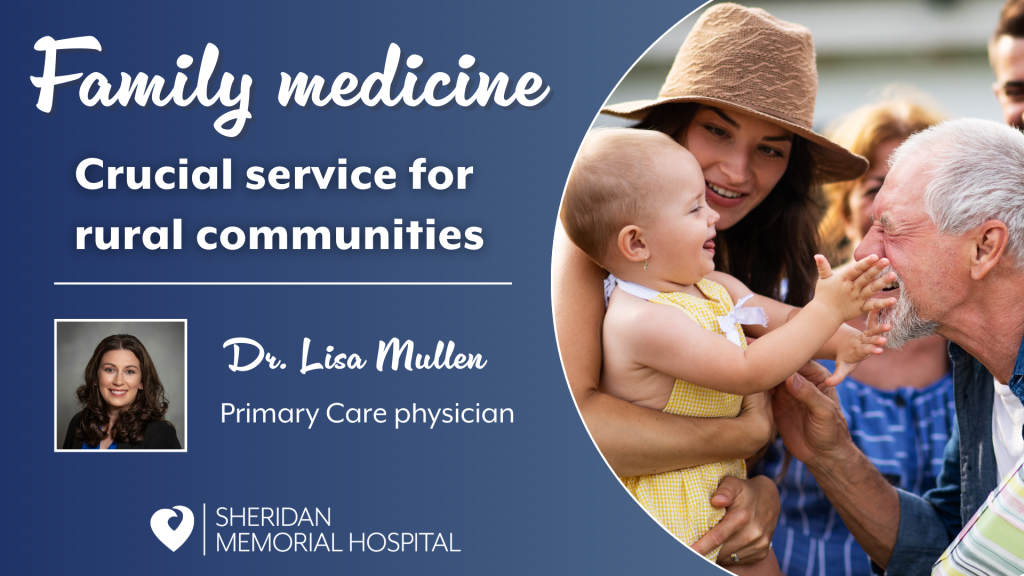
Family medicine delivers comprehensive, lifelong care by treating patients of all ages and addressing a wide range of health needs. Rather than focusing on a single condition or stage of life, family medicine physicians care for individuals and families over time, often serving as a patient’s first — and most consistent — connection to healthcare. At Sheridan Memorial Hospital, family medicine anchors care for many patients across the region.

Family medicine physicians complete medical school followed by three years of residency training dedicated specifically to family medicine. That training equips them to care for children, adults and older adults, and to address preventive care for all ages, women’s health, pediatric care, mental health, chronic disease management and acute illness or injury. This broad preparation allows family medicine physicians to adapt to patients’ changing needs throughout life.

“Family medicine lets us care for the whole person, not just a single problem,” said Dr. Lisa Mullen, a family medicine physician with Sheridan Memorial Hospital Primary Care. Mullen joined the SMH team in 2025 after practicing medicine in Johnson County for several years. “We often care for multiple generations within the same family, which helps us understand health in a much broader context.”

Family medicine is one type of primary care, alongside internal medicine and pediatrics. Pediatricians focus on children, and internists care for adults. Family medicine bridges those specialties by caring for patients from birth through older adulthood. As a result, many families choose one provider who can care for parents and children alike, creating continuity that strengthens trust and communication.

In rural communities, Mullen says, family medicine plays an especially important role. Limited access to specialists in some areas means family medicine physicians often evaluate symptoms, manage ongoing conditions and determine when specialized care is necessary. They also help patients navigate referrals, travel and follow-up care, reducing barriers that can delay treatment.

“In rural healthcare, family medicine physicians rely on broad training and strong clinical judgment,” Mullen said. “We help patients understand their options and guide them to the right level of care when it’s needed.”

Preventive care forms the foundation of family medicine. Family physicians actively promote wellness through cancer screenings, immunizations, routine checkups and conversations about lifestyle, nutrition and physical activity. Because they care for patients over many years, they can recognize patterns, identify risks early and adjust recommendations as patients age.

Family medicine also emphasizes relationship-based care. Long-term relationships encourage honest conversations and shared decision-making. Rather than addressing every concern in a single visit, family physicians build care plans over time, allowing patients to move at a pace that feels manageable and informed.

“Healthcare works best when patients feel heard and supported,” Mullen said. “Family medicine gives us the time and continuity to build that trust.”

Caring for entire families allows family medicine physicians to consider genetics, shared environments and life circumstances that influence health. This perspective strengthens prevention efforts and helps physicians advocate for patients within an increasingly complex healthcare system.

At Sheridan Memorial Hospital, family medicine physicians provide preventive care, acute visits for illness or injury, chronic disease management, pediatric services and women’s health care. Providers at Sheridan Memorial Hospital’s Primary Care clinic, including Dr. Mullen, are currently accepting new patients and welcome individuals and families looking for a trusted place to begin — and continue — their healthcare journey.

To learn more about Dr. Lisa Mullen, visit sheridanhospital.org or click below to listen to her recent appearance on Sheridan Media’s Public Pulse.

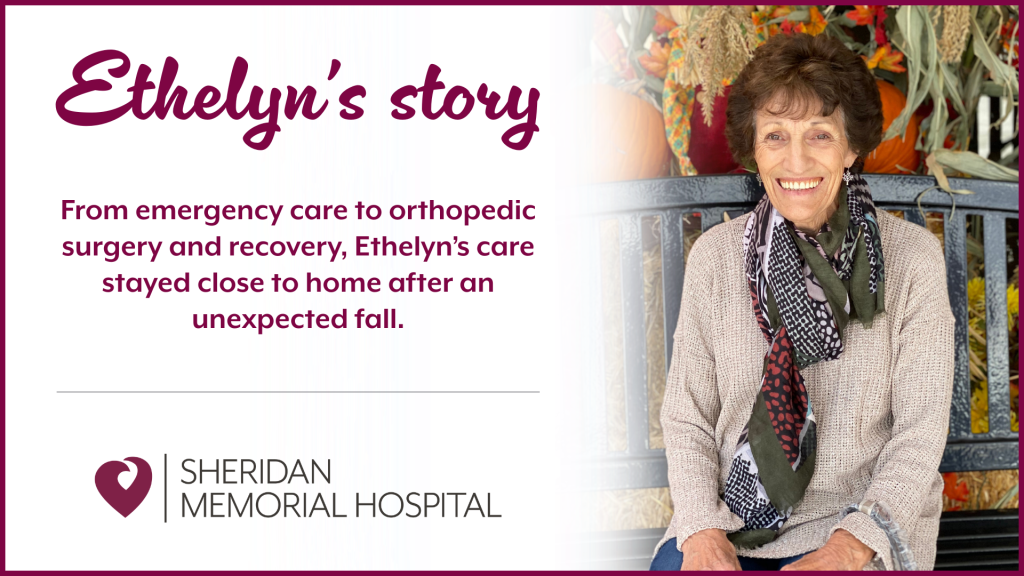
The 2025 holiday season took an unexpected turn for Ethelyn St. John when a simple walk into a friend’s home outside of Dayton ended in a serious injury. As she and two friends headed inside for Thanksgiving dinner, one friend lost her balance and fell backward, knocking St. John to the ground.

Family quickly gathered to help, initially focusing on St. John’s friend, who was bleeding from a head wound. When a friend asked St. John if she could stand, she realized she couldn’t.

“It didn’t really hurt at that moment,” she recalled. “It just felt like there was nothing there.”

Soon, both women were on their way to Sheridan Memorial Hospital’s Emergency Department. While her friend’s head injury initially drew attention, an X-ray quickly revealed the seriousness of St. John’s injury: a shattered hip.

That diagnosis set in motion a swift and efficient chain of events.

“They admitted me and got me into a hospital room right away,” St. John explained. “I saw Dr. Brian Laman quickly, and my surgery was scheduled for the next day.”

St. John was able to stay in Sheridan for her entire surgery and recovery process, surrounded by familiar faces and supported by her family in town, as well as her children, who flew in from Arizona and Oklahoma to be by her side.

Dr. Laman, an orthopedic surgeon at Sheridan Orthopedic Associates, performed St. John’s hip replacement.

“He did a good job,” St. John shared. “He got me in and out pretty fast, and he was so positive about it. He acted like I’d get up off the operating table, get in my car and head home.”

After surgery, St. John moved to Sheridan Memorial Hospital’s Transitional Care Unit (TCU), where she focused on recovery and rehabilitation through occupational and physical therapy with Lexie Prosinski, MOTR/L, and Tiffany Sutton, DPT, PT. During her therapy sessions, St. John practiced walking up and down stairs, built confidence in her movement by walking the hallway while tossing a ball back and forth with her caregivers and learned how to safely get in and out of a car.

That final milestone came full circle for St. John, who volunteers with the hospital’s Auxiliary, which helped fund the car simulator she used during therapy.

St. John’s confidence in her care was reinforced by long-standing relationships at Sheridan Memorial Hospital. During her stay, her primary care provider—Internal Medicine physician Dr. Hannah Hall—stopped by while on duty, and hospital staff members St. John recognized from her 17 years of volunteering checked in on her.

Despite receiving care across multiple service lines, St. John said the transition between departments felt smooth and well-coordinated.

“It didn’t feel strange at all,” she said. “Everything felt seamless.”

Today, St. John admits she’s a bit impatient to be fully back to normal, but she’s staying active, considering chair-based exercise classes and continuing to build strength.

Despite the unexpected nature of her injury, St. John looks back on her experience with gratitude. When asked if she would recommend Dr. Laman, her answer was clear.

“Yes,” she said. “Everyone I know who’s broken a hip, he’s done their surgery. He’s busy, but he’s very kind. Very nice.”

For St. John, receiving expert orthopedic care close to home meant healing faster—and staying connected to the family and community she loves, right here in Sheridan.

When injuries interrupt your life, Sheridan Orthopedics is here to help you get back on your feet. Learn more at sheridanortho.com.

At Sheridan Memorial Hospital, serving the community with excellent, patient-centered care often goes far beyond medications, appointments and surgeries. It’s made possible through mentorship, teamwork and generations of shared experience among staff.

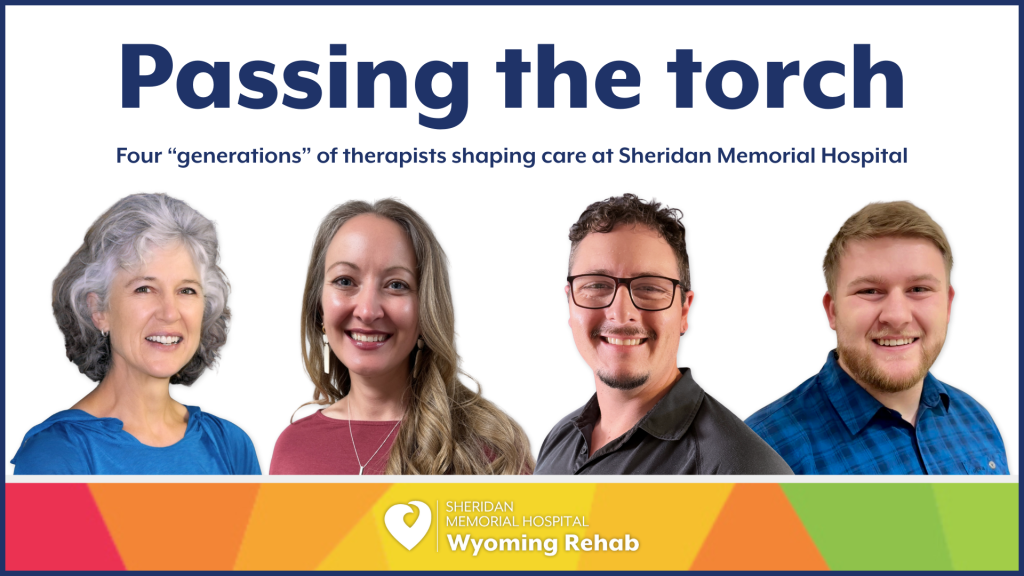
Within the Wyoming Rehab team, four “generations” of therapists—Lisa Mohatt, MS, PT, CWS, CLT; Tiffany Sutton, DPT, PT; Justin Bridger, DPT, PT, CSCS; and Dawson Eppe, PTA—represent more than two decades of learning, teaching and passing the torch.

All four are Sheridan natives. Each left to pursue their education and, in time, returned home—bringing with them not only skills and knowledge, but also a commitment to mentorship that continues to shape the culture and expertise of Sheridan Memorial Hospital’s outpatient and inpatient rehabilitation teams.

“We’ve been teachers for each other, and now we’re colleagues,” said Sutton, who has been a physical therapist on the hospital’s Transitional Care Unit (TCU) for the past eight years. “It’s kind of a weird coincidence.”

The mentorship story begins with Mohatt, a physical therapist at Wyoming Rehab’s outpatient clinic, who mentored Sutton when she was a student therapist. Years later, Sutton mentored Bridger, helping him log observation hours and writing a recommendation letter for his application to physical therapy school. Bridger then stepped into that same role for Eppe, mentoring him through his final clinical rotation as he earned his physical therapist assistant license from Laramie County Community College.

Today, Sutton and Eppe work side by side on the TCU floor, while Bridger and Mohatt support patients in Wyoming Rehab’s outpatient clinic—sometimes even treating those who have graduated from Sutton and Eppe’s care.

“It’s been super fun to connect with Tiffany as a colleague and have conversations with her as an equal,” shared Bridger, who has been with Wyoming Rehab since July 2024. “It’s pretty much unheard of to have four generations of therapists in the same organization. I can see how Lisa influenced Tiffany, how Tiffany influenced me and now how I’ve influenced Dawson.”

Each mentor shaped their successor in different ways. Mohatt exposed Sutton to every corner of the field—from outpatient rehabilitation to home health, wound care, and even aquatics. Bridger recalled how Sutton taught him to maintain high standards and recognize that patients are capable of far more than they often realize. When Bridger mentored Eppe, he emphasized adaptability and compassion.

“One of the things Justin hammered into me was that you have to be able to go from rehabbing a hip to, within 30 seconds, switching to a neurological mindset to rehab a stroke,” reflected Eppe, a physical therapist assistant on the TCU floor for the past three years. “His other big lesson was to lead with compassion. You can go from working with a patient having the best day of their life to another having the worst day of their life, and you have to be able to regulate your emotions and meet each patient where they’re at.”

Bridger remembered his time mentoring Eppe fondly, explaining that his goal was to help Eppe see every patient as a unique individual.

“Dawson was able to capture that lesson and make it his own,” Bridger said. “I’m sure he doesn’t treat every patient exactly the way I do—but that’s the point. Take a lesson and make it your own.”

That culture of sharing knowledge and making it one’s own goes both ways. When Eppe joked that he’s still waiting for the day Sutton or Bridger tell him they’ve used one of his exercises, Sutton laughed.

“Are you kidding?” she replied. “I use your hip hinge trick all the time!”

Bridger added that he’s learned something from every student, and that many times, it isn’t clinical knowledge he takes away from mentoring, but insight into different ways to approach and solve problems.

Mohatt agreed, noting that mentorship benefits both teacher and student.

“Mentoring has shown me that each generation has so much to offer, and how important it is to encourage that continued growth so physical therapists can keep helping people more effectively,” Mohatt explained.

The culture of mentorship extends beyond the workplace. Eppe is currently helping Sutton’s daughter recover following hip surgery—a full-circle moment for them both.

And as Eppe begins mentoring his own students, the legacy continues.

“It’s very humbling when you’re asked to teach the next generation,” he said. “When I’m teaching someone, that’s when I feel like I’m at the top of my game, because I have to keep up with the new things students are learning in school, while also showing them what the standard is. It also reminds you how awesome your job is.”

Sutton agreed, adding that growth and curiosity are key to lasting success in the field.

“The moment you think you know it all is when it’s time to hang up your hat,” she said.

Mohatt added that physical therapists play a vital role in a patient’s overall healthcare journey.

“It’s important for physical therapists to truly care about people and their health,” she said. “We need to understand our role in helping patients get better—not just physically, but mentally, as well.”

Together, this multi-generational approach to mentorship and healthcare creates more than professional growth. It fosters a positive, collaborative work environment and strengthens patient care. When knowledge, philosophy and compassion are intentionally passed from one therapist to the next, patients benefit from consistent, thoughtful care throughout their healthcare journey.

“Through community and mentorship, we become more than individuals,” Bridger said. “Through mentorship, we learn our own biases and reframe our thinking, which not only helps the next generation, but also improves care for our patients.”

Learn more about the exceptional care provided through Wyoming Rehab and the TCU at sheridanhospital.org/medical-services/rehabilitation-services/ and sheridanhospital.org/medical-services/transitional-care/.

Are you ready to take the next step in your career and join a workplace that values mentorship, growth and community? Visit sheridanhospital.org/about-us/careers/ to explore current job opportunities and apply today.

For decades, Sheridan Memorial Hospital’s Women’s Health nurses have guided families as they welcome new babies. Now, two of those nurses—Jeanna Duncan, MSN, RNC-OB, SpBCBP, and Cassie Aust, RN, CLC, SpBCBP—bring an added level of expertise to labor and delivery as Sheridan Memorial Hospital’s first Certified Birth Professionals.

Together, Duncan and Aust represent more than 40 years of combined experience in Sheridan Memorial Hospital’s Women’s Health and Labor and Delivery department. Duncan joined Sheridan Memorial Hospital in 2001 after working in hospitals in Riverton and Lander. Aust began as a certified nursing assistant in the Women’s Health department in 2009 and has spent the last 16 years caring for laboring mothers while growing into her nursing career.

Their decision to become Certified Birth Professionals stemmed from a shared desire to strengthen their skills and better support both their patients and fellow team members.

“Women are so powerful, and sometimes we forget what our bodies are capable of,” Aust said. “When we work with the pregnant body and certain positions, balance, and relaxation, it helps support the labor process. I’m passionate about helping women feel strong and empowered during birth.”

Sheridan Memorial Hospital’s manager of Women’s Health and Pediatrics, Kim George, BSN, RN, RNC-OB, praised Duncan and Aust’s motivation to pursue certification, noting that it reflects a broader commitment to excellence within the department.

“I am so proud of Jeanna and Cassie for pursuing certification as birth professionals,” George said. “Their dedication to continuing education strengthens our labor and delivery services and reinforces our hospital’s commitment to excellence. Ongoing professional development allows our nursing team to grow as leaders, mentors and advocates for our patients, ensuring we deliver safe, compassionate and high-quality care.”

The certification, earned through Spinning Babies’ intensive program, is designed to facilitate empowered birth experiences by focusing on physiologic birth and teaching evidence-based techniques that support balance, positioning and movement during labor. Rather than viewing labor challenges as problems to be fixed, the Spinning Babies approach helps create space and alignment in the body to support the natural process of birth.

“It’s not that the baby is in the wrong position,” Aust explained. “It’s about helping them find their way into the world by working with the mother’s body.”

The certification process included extensive online coursework, followed by a four-day, hands-on training in Portland, Oregon, alongside midwives, doulas and nurses from across the country.

“It was fun to see everyone’s knowledge and experience all in one room,” Duncan recalled. “Everyone brought different experiences, and we learned so much from each other.”

Since earning their certification, both nurses have already utilized their new skills at the bedside and shared techniques with coworkers.

“It’s fun because everyone’s excited about it,” Aust said. “We troubleshoot together. We try different things.”

Sometimes, those small adjustments make a big difference.

“It’s really simple stuff,” Duncan added. “But it can prevent hours of labor interventions.”

Aust shared an example of a recent patient whose labor had stalled, leaving the patient feeling increasingly anxious. To help, Aust guided the patient through a side-lying release—a Spinning Babies technique designed to address pelvic imbalance and create space for the baby to move into a more optimal position, which can contribute to more efficient labor progression.

Aust also used a technique known as “The Jiggle,” in which a caregiver gently applies small, rhythmic movements to the patient’s lower back, hips or pelvis. This technique is used to help improve balance and relaxation in the pregnant body.

Duncan and Aust are the first Certified Birth Professionals at Sheridan Memorial Hospital.

“It’s something we’re really proud of,” Aust said. “There’s a movement toward helping women have the birth experience they’re hoping for in a way that feels natural and supported.”

Beyond physical techniques, the certification places strong emphasis on informed consent and patient autonomy.

“This didn’t just teach positioning,” Duncan said. “It reinforced that this is the mother’s body and her birth experience. We’re here to support her—not make decisions for her.”

For Aust, an empowered birth experience means ensuring mothers understand their options and feel confident in their choices.

“The training encouraged us to take the time to get informed consent and empower mothers to know that they can do this,” she said. “We’re here to guide and support them so the experience is one they ultimately feel good about.”

Duncan added that families can explore resources—such as spinningbabies.com—ahead of time, come prepared with questions and engage more deeply in their care.

For expectant families, this certification means their care team at Sheridan Memorial Hospital is committed to learning, growth and individualized, compassionate support.

“We’re excited about this,” Aust said. “We’re passionate about this work, and we will continue keep learning and be there for our patients.”

To learn more about Sheridan Memorial Hospital’s Women’s Health services, visit sheridanhospital.org/medical-services/womens-health/.

When robotic-assisted surgery was introduced at Sheridan Memorial Hospital in 2022, it represented a bold investment in the future of local healthcare. At the time, three surgeons began using a single robotic system to perform advanced minimally invasive procedures — bringing cutting-edge surgical technology closer to home for patients who previously may have needed to travel for that level of care.

Just a few years later, that investment has grown into something even more meaningful.

Today, the hospital proudly offers two state-of-the-art robotic-assisted surgical systems, led by eight specially trained surgeons across multiple specialties. This expansion reflects not only the success of the program, but also the growing demand from patients seeking the benefits of robotic-assisted surgery — right here in their own community.

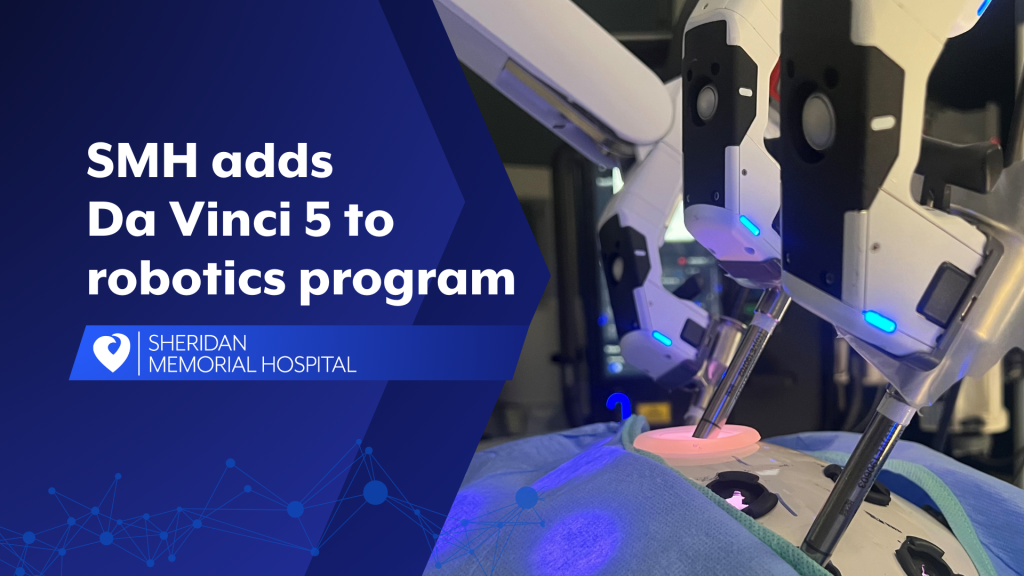
The growth was driven by both clinical outcomes and utilization. Prior to expansion, the hospital’s original robotic system — a da Vinci Xi — was being used at nearly 80 percent capacity, a clear signal that the program had outgrown its initial footprint. In response, hospital leadership made a strategic decision: upgrade the original system to the newest da Vinci 5 platform and add a second robotic system to better serve patients and healthcare providers alike.

Robotic-assisted surgery allows surgeons to perform complex procedures through small incisions using enhanced visualization, precision instruments and advanced control. The da Vinci 5 system offers improved ergonomics, refined instrumentation and advanced technology designed to support surgeon performance while maintaining a strong focus on patient safety.

At SMH, robotic-assisted systems are now used for a wide range of procedures, including general surgery, urologic surgery, gynecologic procedures, colorectal surgery and other minimally invasive interventions. These systems support procedures such as hernia repairs, gallbladder removal and hysterectomy, as well as bariatric and urologic procedures — all of which benefit from precision and minimally invasive approaches.

For patients, the advantages are significant. Robotic-assisted surgery often means smaller incisions, less blood loss, reduced pain, shorter hospital stays and faster recovery times. Many patients are able to return to normal activities sooner, with fewer complications and improved overall surgical experiences. Just as important, patients can access this level of advanced care without leaving their community, close to family, support systems and trusted providers.

For surgeons, the technology enhances dexterity and visualization, translating to more precise movements and improved access in complex anatomical areas. The result is a collaborative environment where technology supports clinical expertise — never replacing it, but elevating it.

The expansion of robotic-assisted surgery is more than a technology upgrade; it is a reflection of the hospital’s ongoing commitment to delivering excellent, patient-centered care. By investing in advanced surgical systems and expanding the team of trained surgeons, the hospital continues to meet the evolving needs of the community while ensuring patients receive care that is both modern and compassionate.

What began in 2022 with three surgeons and one system has become a thriving surgical program—one that demonstrates how innovation, when paired with community values, can transform healthcare close to home.

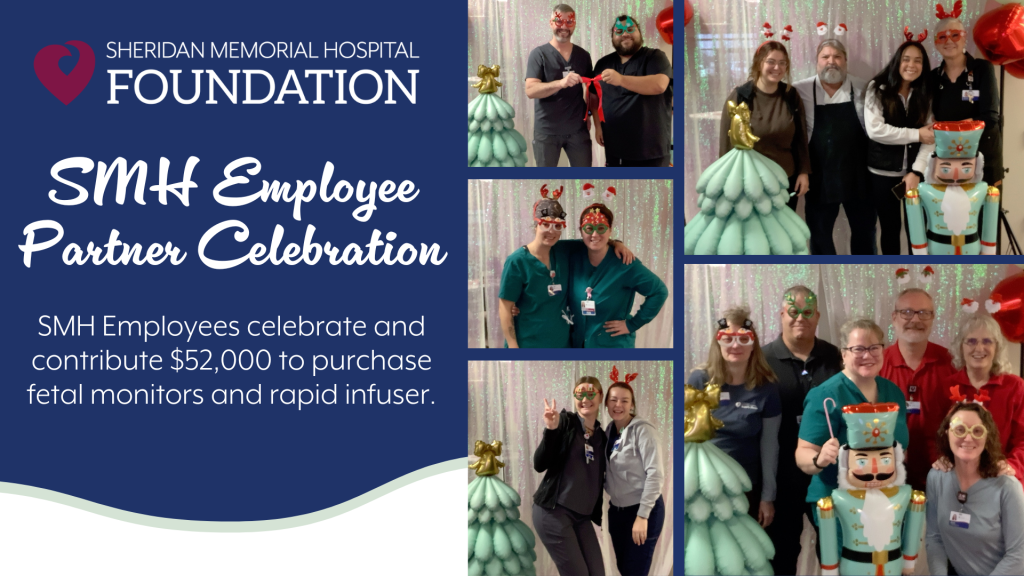
On Wednesday, Dec. 10, 2025, the Sheridan Memorial Hospital Foundation hosted its annual holiday breakfast to honor and celebrate Employee Partners for their contributions to the hospital’s Foundation. During the event, Partners vote to fund a strategic project in the hospital’s area of greatest need, with the funds accumulated over the past year. In 2025, 637 employee partners participated in this unique philanthropic program and donated $52,506 through biweekly payroll deductions.

At this year’s celebration, Employee Partners at Sheridan Memorial Hospital made a significant contribution to our community hospital by voting to support equipment purchases. By voting to purchase fetal monitors and a rapid infuser, Employee Partners strengthened care from within by supporting their fellow employees with vital resources that help deliver the highest quality care to our community. SMH employees’ generosity and dedication to improving patient care daily make Sheridan Memorial Hospital a place where compassion leads.

The Employee Partner program at Sheridan Memorial Hospital has a long history of making a positive difference in patient care.

Founded in 2004 by a group of committed employees eager to give back to their community, the program has grown steadily over the past 22 years. During that time, Employee Partners have contributed more than half a million dollars to patient care improvement projects at our community hospital. As new, passionate employees continue to join the program, they are helping build a lasting legacy of generosity at philanthropy at our community hospital.

“We are so grateful for our employees each and every day,” shares Chief Development Officer Cody Sinclair. “The Employee Partner Program is another way our employees embody a culture of kindness and commitment to patient care. The Foundation would not be as successful without our employees’ unwavering commitment to care for the visitors, families and patients we serve. As we look to the future, we are grateful for the ongoing support of Employee Partners and the difference they continue to make in healthcare in our community. Together, we are building a stronger future for all who depend on Sheridan Memorial Hospital for their care.”

For more information about the Sheridan Memorial Hospital Foundation, please contact our team at 307.673.2418 or visit sheridanhospital.org/foundation.

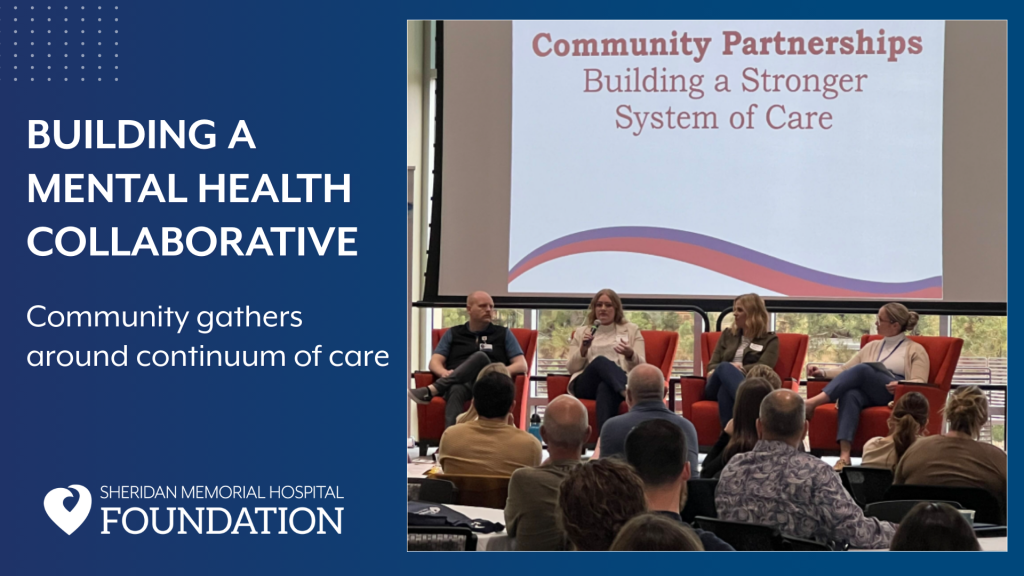
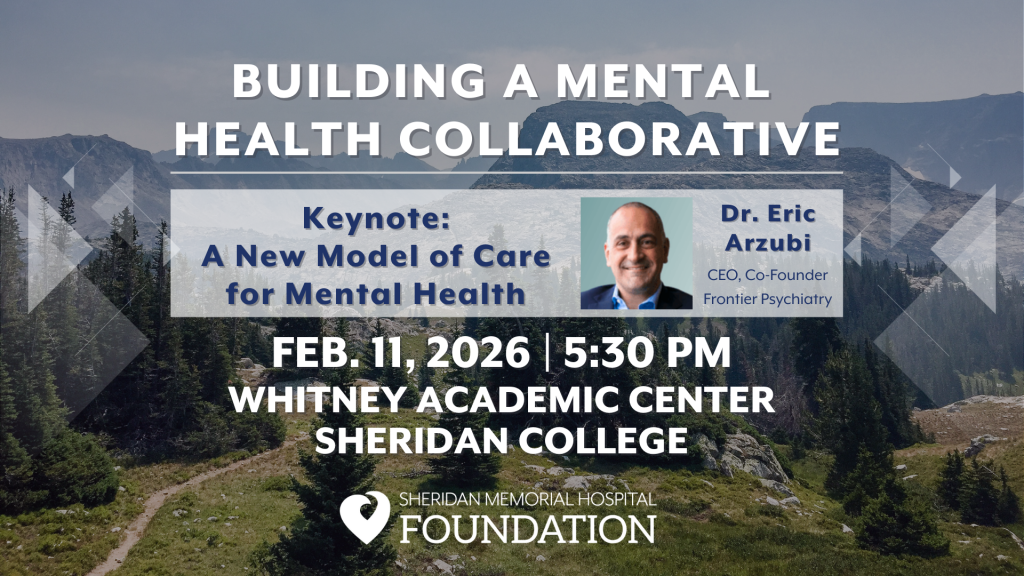
Sheridan Memorial Hospital in partnership with the Sheridan Memorial Hospital Foundation will host “Building a Mental Health Collaborative” Wednesday, Feb. 11, at Sheridan College. The event aims to foster partnerships and collaboration among individuals, nonprofits and businesses that work in mental health in Sheridan and Johnson counties.

While the half-day event includes panel discussions and workshops for mental health professionals regarding access to care, challenges and resources, the event will conclude with a public presentation from keynote speaker Dr. Eric Arzubi at 5:30 p.m. in the Whitney Academic Center atrium.

Arzubi is a physician consultant with the EmPATH Consulting team, a board-certified child and adolescent psychiatrist, CEO of Frontier Psychiatry, and assistant clinical professor at the Yale Child Study Center. In 2018, he led the creation of Montana’s first EmPATH unit at Billings Clinic, personally mentored by EmPATH founder Dr. Scott Zeller. The unit served approximately 15 patients daily, reduced psychiatric emergency wait times from 10 hours to under four hours, and significantly decreased hospitalization and readmission rates.

Arzubi presented at the inaugural EmPATH Summit in 2025 and now leads a telehealth practice delivering more than 5,000 monthly visits across Montana, Idaho and Alaska. His 2025 JAMA Network Open-published research demonstrates 38% lower hospitalization rates and 18% fewer ER visits. He successfully introduces innovative solutions across the behavioral health continuum of care, with a proven track record of scaling solutions in underserved communities. He also led the creation of Montana’s first psychiatry residency training program.

Kim DeGraw is the activities director at Sheridan Green House, a long-term care facility operated by Sheridan Memorial Hospital.

Before beginning work as an activities director at Sheridan Green House, I held the same assumptions many people do. Growing older means fewer choices and less freedom. Our bodies protest and our minds tire, so aging must mean a gradual stepping back from the life you once knew. What the elders I work with have taught me, though, is that none of that has to be true.

Aging is about redefining your purpose, not abandoning it.

The elders I see day in and day out want to contribute. They want to set the table, rinse a dish, fold laundry, share a story, teach a card game or offer advice. These may seem like small tasks, but they matter. Purpose doesn’t disappear with age — it just looks a little different.

Elders have also shown me independence is a spectrum. Freedom maybe used to feel like driving on back roads with the windows down, but now it centers around decisions like when to wake up, what to eat, where to sit or how to spend the afternoon. Often elders have more freedom to spend their time how they choose than younger generations in the throes of raising families and working.

While I often remind elders that movement matters, nobody is expecting a marathon. Activity can mean walking, hallway bowling or simply getting up to join a conversation. Staying active, it turns out, is less about the activity itself and more about engagement with the world around you.

This is why mental stimulation is just as important. One of my favorite discoveries has been how powerful curiosity remains later in life. When we explore other cultures, listen to unfamiliar music or talk about places someone has never been, something sparks. Learning doesn’t have an expiration date.

Social connection may be the most powerful lesson of all. Nearly every day, I see meals transform as conversations help bridge the past and present. A single story recalls memories in others and creates a sense of belonging among friends. While so many of us eat meals while scrolling our phones or working at our desks, elders take the time to connect.

There is no denying, though, that aging brings change and often loss. Loss of mobility, loss of memory, loss of loved ones. But elders have taught me about resilience, and shown how much better they adapt when supported. Humor helps, too.

Perhaps the most surprising lesson has come from watching generations connect. Children sitting with elders, reading books, listening to stories, asking questions — these moments matter more than most. Children remind elders that their lives, their memories and their voices carry weight. And elders teach younger generations empathy, patience and perspective.

While these are all important lessons – about independence, activity, social connection, resilience and relevance – the primary thing elders have taught me is that life doesn’t narrow with age unless we let it. Connection, curiosity and joy are available at every stage of life — if we choose to make space for them.

That’s a lesson worth carrying with us, no matter our age.

Hear more from the team at Sheridan Green House. The team appeared on Sheridan Media’s Public Pulse in December. Listen here:

Please note that many of our clinics and services will be closed or operating on adjusted hours from Wednesday, Dec. 31, through Friday, Jan. 2, so our team members can celebrate the new year with their families, friends and loved ones. Please see the list below for closures and adjusted hours.

As always, our Emergency Department is open 24/7/365 to care for any urgent needs.

If you have any questions about clinic hours, call the clinic directly or our main hospital line at 307.672.1000.

Clinic or service Adjusted hours & closures
Addiction Medicine Closed Jan. 1
Admissions Desk Open Dec. 31 and Jan. 1, but with limited staff
Behavioral Health Closed Jan. 1
Big Horn Surgical Open Dec. 31 from 8 am – 4 pm
Closed Jan. 1
Cafeteria Open Dec. 31 & Jan. 1
Continental breakfast available for purchase
Limited grab-n-go
No soup or salad bar
Cardiopulmonary Rehabilitation Open Dec. 31 from 6:30 am – 12 pm
Closed Jan. 1
Case Management Open Dec. 31 & Jan. 1
Diabetes Education Open Dec. 31 from 8 am – 3:30 pm
Closed Jan. 1
Ear, Nose & Throat, Allergy & Audiology Open Dec. 31 from 8 am – 1 pm
Closed Jan. 1 & 2
Emergency Department Open 24/7/365
 Financial Advocates Closed Jan. 1
Health Information and Records Open Dec. 31 from 8 am – 3 pm
Closed Jan. 1
Heart Center Closed Jan. 1
HomeCare & Hospice Closed Jan. 1
Nurse on-call
Hospital Pharmacy West Open Dec. 31 from 8:30 am – 2 pm
Closed Jan. 1
Internal Medicine Closed Jan. 1
Outpatient Infusions Closed Jan. 1
Outpatient Lab Closed Jan. 1
Outpatient Radiology Closed Jan. 1
Patient Financial Services   Closed Jan. 1
 Patient Scheduling  Closed Jan. 1
Primary Care & Primary Care Lab  Open Dec. 31 from 8 am – 2 pm
Closed Jan. 1
 Rheumatology  Open Dec. 31 from 8 am – 12 pm
Closed Jan. 1
SameDay Health & Imaging Open Dec. 31 from 6:30 am – 2 pm
Closed Jan. 1
Sheridan Green House Administration Office Closed Jan. 1
Sheridan Orthopedic Associates Closed Jan. 1
Provider on-call
Sidewalk Café Closed Jan. 1 & 2
Spine Center of the Bighorns Closed Jan. 1 & 2
Welch Cancer Center Closed Jan. 1
Provider on-call
Wound Care Closed Jan. 1
Wyoming Rehab Closed Jan. 1

Please note that many of our clinics and services will be closed or operating on adjusted hours from Wednesday, December 24, through Friday, December 26, so our team members can spend the holiday with their families, friends and loved ones. Please see the list below for closures and adjusted hours.

As always, our Emergency Department is open 24/7/365 to care for any urgent needs.

If you have any questions about clinic hours, call the clinic directly or our main hospital line at 307.672.1000.

Clinic or service Adjusted hours & closures
Addiction Medicine Closed Dec. 24 – 26
Admissions Desk Open Dec. 24 and 25, but with limited staff
Behavioral Health Closed Dec. 24 – 26
Big Horn Surgical Open Dec. 24 from 8 am – 12 pm
Closed Dec. 25 and 26
Cafeteria Open Dec. 24 and 25 with limited grab-n-go and no soup or salad bar. Continental breakfast available for purchase.
Cardiopulmonary Rehabilitation Closed Dec. 24 – 26
Case Management Closed Dec. 25
Diabetes Education Closed Dec. 24 and 25
Ear, Nose & Throat, Allergy & Audiology Closed Dec. 24 and 25
Emergency Department Open 24/7/365
 Financial Advocates Closed Dec. 25
Open Dec. 26 from 8 am – 12 pm
Health Information and Records Open Dec. 24 from 8 am – 12 pm
Closed Dec. 25 and 26
Heart Center Open Dec. 24 from 8 am – 12 pm
HomeCare & Hospice • Closed Dec. 24 and 25, but with a nurse on-call
Hospital Pharmacy West Closed Dec. 24 and 25
Internal Medicine Open Dec. from 8 am – 12 pm
Closed Dec. 25 and 26
Northeast Wyoming Pediatric Associates Open Dec. 24 from 8 am – 12 pm
Closed Dec. 25
Patient Financial Services Open Dec. 24 from 8 am – 12 pm
Closed Dec. 25
Patient Scheduling Open Dec. 24 from 8 am – 12 pm
Closed Dec. 25
Primary Care & Primary Care Lab Open Dec. 24 from 8 am – 12 pm
Closed Dec. 25
Outpatient Lab Open Dec. from 6:30 am – 12 pm
Closed Dec. 25
Open Dec. 26 from 6:30 am – 12 pm
Outpatient Radiology Open Dec. 24 from 8 am – 12 pm
Closed Dec. 25
Rheumatology Closed Dec. 25 – 26
SameDay Health & Imaging Open Dec. 24 from 6:30 am – 2 pm
Closed Dec. 25
Sheridan Green House Administration Office Closed Dec. 25
Sheridan Orthopedic Associates Closed Dec. 24 – 26, but with a provider on-call
Sidewalk Café Closed Dec. 25 and 26
Spine Center of the Bighorns Open Dec. 24 from 8 – 11 am
Closed Dec. 25 and 26
Welch Cancer Center Closed Dec. 25 and 26, but with a provider on-call
Wyoming Rehab Open Dec. 24 from 8 am – 12 pm
Closed Dec. 25

Written by Josie Fagerland, BSN, RN, RNC, a nurse on the Women’s Health and Pediatric Units at Sheridan Memorial Hospital.

Parents, grandparents, babysitters and caregivers play a vital role in infant safety. The team at Sheridan Memorial Hospital encourages families to carry the same evidence-based habits home to protect their baby every day.

For us, this means following the ABCs (Alone, Back, Crib):

  • Alone: Your baby should sleep without pillows, blankets, toys or bumpers in their sleep space.
  • Back: Always place your baby on their back for naps and nighttime sleep.
  • Crib: Use a firm sleep surface with a fitted sheet in your child’s crib.

Once a baby can roll from back to front independently, they may remain in the position they choose —but they still need a safe, uncluttered sleep space.

 Creating a safe sleep environment

A few simple steps can dramatically reduce risks for infants while they sleep.

  • Use a firm mattress with no gaps.
  • Keep the room smoke-free.
  • Maintain a comfortable temperature — not too warm.
  • Use sleep sacks instead of loose blankets.
  • Offer a pacifier at sleep time if your baby accepts one.

While car seats, swings, baby carriers and slings are helpful for travel or awake time, they are not safe for routine sleep. If your baby falls asleep in one, move them to a safe sleep surface as soon as possible.

Preventing drops, falls at home

One of the most common causes of infant drops is caregiver fatigue. If you feel sleepy — during late-night feedings, for example — place your baby safely in the crib before resting. Never risk falling asleep with your baby in your arms or on a couch or chair.

  • Always sit before picking up your baby if you feel tired or unsteady.
  • Never transfer a sleepy infant between people unless both caregivers are fully alert and prepared.
  • Keep floors free of clutter, cords or tripping hazards.

Healthcare providers work through safe sleep education with parents when they are admitted for the birth of their child, throughout their stay at the hospital and again before discharge. Women’s health and pediatric healthcare providers are also available to answer questions about safe sleep practices, but infant safety is a community effort. When families, healthcare providers and caregivers work together and share safe sleep knowledge, we prevent injuries before they happen — and help every child sleep safely.

For more information on community safe sleep resources, local classes or hospital education materials, families are encouraged to contact Sheridan Memorial Hospital’s Women’s Health Department. Together, we can ensure every baby has the safest start in life.

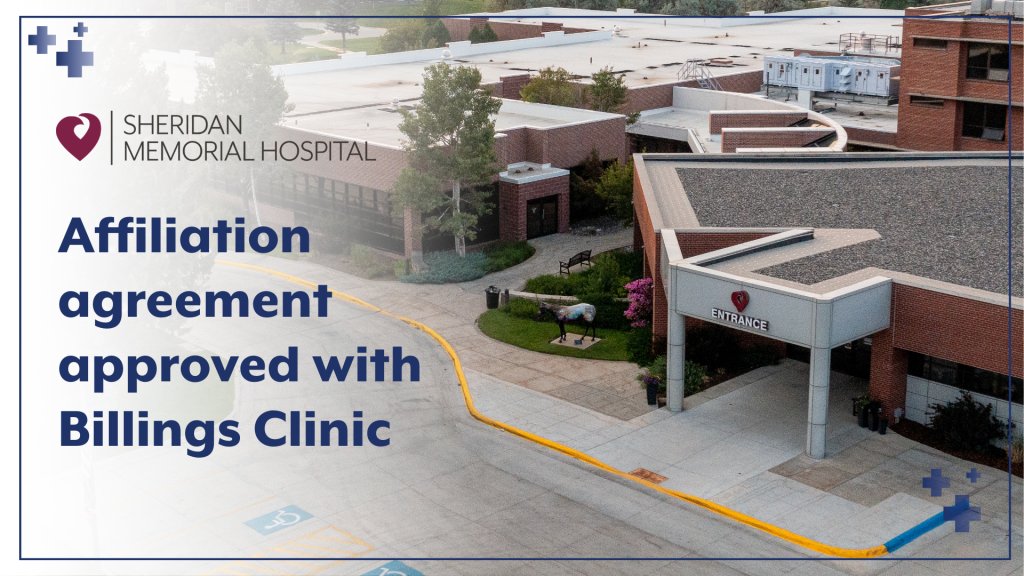
Sheridan Memorial Hospital CEO Mike McCafferty joined Public Pulse in November to talk about a potential affiliation with Billings Clinic and provide updates the SMH healthcare system.

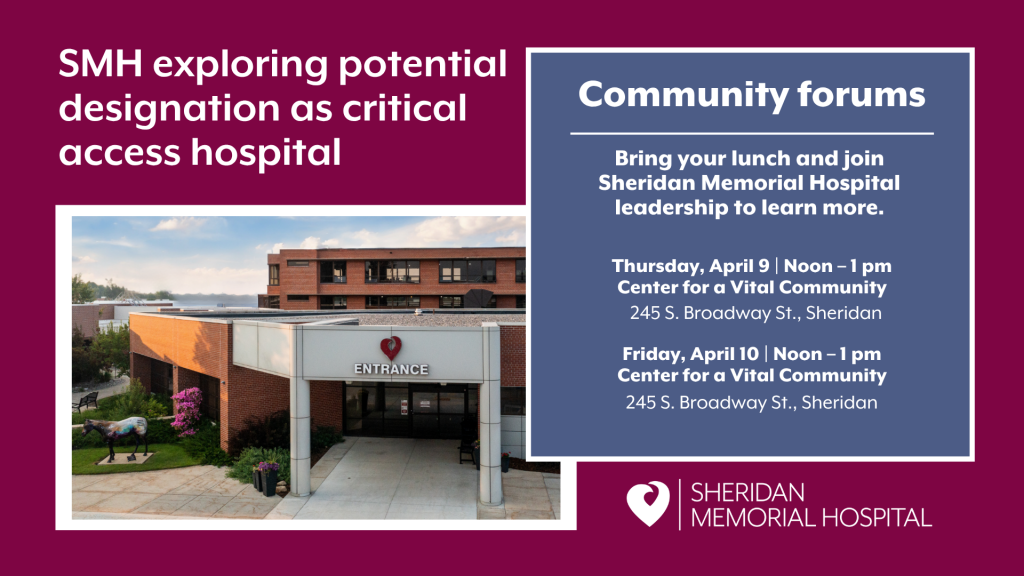
With the mission of continuing to serve the community with excellent, patient-centered care firmly in focus, Sheridan Memorial Hospital (SMH) has begun exploring a strategic partnership with Billings Clinic. Hospital CEO Mike McCafferty spoke to the potential affiliation in a board of trustees meeting Oct. 22, and has spent time over the last year sharing information about the evolving dynamics of the healthcare industry and challenges faced by rural healthcare systems.

Despite the challenges, Sheridan Memorial Hospital has consistently invested to meet the needs of the Sheridan community and surrounding region. As a result, community members have access to a wide array of services including cancer care, cardiology, rheumatology, obstetrics, addiction medicine and behavioral health.

“The strength of these local services are indicative of how we have continuously chosen to serve our mission and the community,” McCafferty said.


Listen now by clicking below!

Cooper George, a fifth-grader at Big Horn Elementary School, won the top prize in Sheridan Memorial Hospital’s annual Christmas Card Art Contest.

George’s design will be featured on the hospital’s annual holiday card and she will receive a cash prize.

Liberty Quinn Jacobson, a Meadowlark Elementary School fifth-grader, received an honorable mention for a design featuring the WYO Theater. Jacobson will also receive a prize.

Each year, the hospital accepts entries from third-, fourth- and fifth-grade students in Sheridan County, Wyoming, for the contest.

Artwork provided by students is then judged by a committee and the overall winner’s design is used on the card sent out in December 2025. All entries are displayed at the hospital throughout the Christmas season and shared on the hospital’s website and social media channels.

The theme for this year’s art contest is “Community Christmas.”

Still looking for gift ideas for your family, friends or coworkers?

Gift cards to Sheridan Memorial Hospital’s cafeteria or Sidewalk Café are available for purchase year-round — and they make great, easy Christmas presents!

Stop in today to pick up a stocking stuffer the whole family can enjoy!

Sidewalk Cafe is located in the Outpatient Center at 1333 W. Fifth St. and the cafeteria at SMH is located on the north side of the facility on the lower level.

Please note that employees may use their badge to purchase gift cards in the cafeteria only. Badge payment is not currently available for gift cards to the Sidewalk Café.

The Sheridan Memorial Hospital Foundation is honored to announce a generous $100,000 matching contribution from the Grainger Family to the Growing for You Campaign. At the initiation of Sheridan Memorial Hospital (SMH) Foundation’s Growing for You – Behavioral Health and Emergency Medicine Campaign, the SMH Foundation team worked to connect with passionate supporters of our rural, community hospital who share in our continued efforts to support excellent patient-centered care right here at home. Support of this campaign not only supports Sheridan Memorial Hospital’s investment in Behavioral Health, but the subsequent repurposing of space to better serve our patients in numerous departments throughout the hospital. Early on in campaign efforts, The Thomas and Elizabeth Grainger Family Charitable Fund committed to a $300,000 pledge, supporting the campaign and enhancement of behavioral health services available to the region. As we conclude our fundraising efforts, this challenge emphasizes the importance of this initiative and expresses a desire for others to recognize and support the meaningful impact it will have on rural Wyoming communities.

“This family has created a philanthropic legacy through their support of healthcare, and other initiatives, across the country,” shares Sheridan Memorial Hospital Chief Development Officer, Cody Sinclair. “From our first interactions, we immediately felt their passion to make a positive difference. Not only does this additional gift reinforce their support, but it is intended to help to inspire others to get involved and help to complete fundraising efforts for the Behavioral Health Unit.”

The Need for Behavioral Health in Wyoming

In rural communities like those in Sheridan and Johnson counties, wide-open spaces and long dirt roads can make help feel far away, but a new behavioral health outpatient clinic at Sheridan Memorial Hospital has spent its first year proving that care can be both close to home and deeply personal.

The current SMH behavioral health team is currently comprised of one psychiatrist, a licensed clinical social worker, medical administrative assistant and director. They have seen more than 400 patients and has served as a resource for inpatient teams caring for patients in other areas of the hospital, including the Emergency Department.

Support from over 800 contributors has allowed behavioral health care to become more readily available in our region and made it possible for our patients to receive excellent medical care – right here at home. It is because of this generosity, that our community will have better access to vital behavioral health care through all stages of their journey. The Behavioral Health facility at SMH will include four levels of care — an outpatient clinic, behavioral health urgent care, crisis stabilization and inpatient care.

Early Results Through Coordination and Collaboration

While data has shown the early successes of the program, the opening of a new Behavioral Health facility at SMH will further the efforts already underway.

Since opening in November 2024, the Behavioral Health Clinic at Sheridan Memorial Hospital has taken a systematic approach to breaking down barriers to mental health care. The clinic has helped clarify diagnoses, connect patients with community resources and reduce the number of involuntary holds related to mental health crises. These improvements are the result of specialized behavioral health expertise and strong partnerships with Sheridan Memorial Hospital’s primary care, emergency and hospitalist teams — alongside close collaboration with local mental health providers and law enforcement.

Early data suggests the team’s approach to caring for community members’ behavioral health needs is working. A review of the first year shows a 24 percent decrease in involuntary holds under Title 25 and a 46 percent decrease in the number of days behavioral health patients have been in the hospital at SMH. This data indicates individuals are receiving the right care at the right time to match their needs.

“Data and numbers are a pivotal part of my work every day,” Tom Grainger shares. “For these types of results, and quantitative data to exemplify success, it solidifies the need for these services, this unit and our investment in proactive mental and behavioral healthcare.” True to their word, the current $100,000 matching challenge is to help educate our community on the need and inspire others to give. “Collectively we can achieve more. By joining us in supporting these efforts at Sheridan Memorial Hospital, we are not just saying we believe in this work, but showing up to make a difference.”

Unlocking the $100,000

Behavioral health challenges touch countless families, friends, neighbors, and coworkers in ways often unseen but deeply felt. When we come together, we create a stronger network of support that ensures people in need can access exceptional care close to home.

All funds raised toward the Growing for You Campaign will go toward the challenge match and support the hospital’s financial commitment to the project. This means any contributions to this campaign through pledges or end of year giving, no matter the size, are met dollar for dollar to ensure those struggling with mental health have “a place to go.”

We invite you to make a lasting difference, contribute to unlocking the generous $100,000 challenge made by the Grainger Family and help build the behavioral health resources our community deserves. Your gift today strengthens the safety net for those who might be silently struggling by offering hope, healing, and a path forward.

For more information on the Growing for You campaign, how you can support this vital expansion, or questions on how to maximize your gift this year, please visit sheridanhospital.org/foundation or calling The Foundation at 307.673.2418.

On Saturday, Oct. 18, the Sheridan Memorial Hospital Foundation proudly hosted The Link – Partners in Pink, its 17th annual run/walk to raise awareness and funding for cancer care and healing in our community. During the beautiful fall day, more than 600 participants, volunteers and cancer survivors were in attendance, filling Whitney Commons Park with energy, hope and plenty of pink!

Thanks to the incredible generosity of participants, sponsors and donors, the event proceeds of over $50,000 will support the Comfort Care Program at Sheridan Memorial Hospital’s Welch Cancer Center (WCC). The program at the WCC is overseen by the Director of Continuous Improvement – Tommi Ritterbusch, and the WCC Manager – Megan Ripley. With the help of WCC’s dedicated team, funds are available to cancer patients facing all cancer types and help provide them with the most comfortable experience during their cancer journey.

“No cancer journey is the same, but these funds and the WCC team are here to ensure that each patient is supported throughout their diagnosis,” shares Chief Development Officer Cody Sinclair. “The heart of The Link has always been our community’s willingness to walk alongside patients and families facing cancer. Every dollar raised provides care, comfort and hope ensuring that no one goes through their cancer journey alone.”

Every year, there are outstanding partners for the Link Partners in Pink. Shelley Kinnison and her Born in a Barn (BIAB) team donated $19,759 to The Foundation’s efforts through the mimosas sold at their annual BIAB weekend. Thanks to sharing their “why” and passion for this project, BIAB has contributed over $70,000 to comfort care and the efforts of the WCC and their comfort care funds.

Another great example is the Sheridan Hawks Jr. Hockey Club, which hosts a “Hawks Hockey Fights Cancer” weekend, which includes puck drops from survivors and their annual Jersey Auction with special cancer awareness jerseys. We appreciate their efforts during our Link weekend and loved having the entire team with us this year to join in the community spirit! It is really special to see the team donning their Link shirts & raising awareness for the cause, and becoming invested in the community they temporarily call home.

The Link-Partners in Pink volunteers and Foundation staff thank all those who participated, sponsored, made a donation and volunteered their time. Major sponsors of this year’s event include Ebzery Family Foundation, First Federal Bank & Trust, First Interstate Bank, DA Davidson, Dr. Rebecca Franklund & Mr. Brad Wilhite, Intermountain Health, Powder River Heating & AC, Range, and Sheridan Community Federal Credit Union. Thanks to our caring supporters, participants, and sponsors, cancer education and prevention resources are now more accessible to our community.

For more information about Welch Cancer Center’s Services or Patient Comfort Care Fund please contact the Welch Cancer Center directly at 307.674.6022 or The Foundation at 307.673.2418.

We are thrilled to share Holiday Happenings at Sheridan Memorial Hospital (SMH) thanks to the tireless efforts of The Sheridan Memorial Hospital Auxiliary and Volunteers. These holiday events put on by our dedicated hospital volunteers are cherished traditions here at SMH and we look forward to celebrating with you this holiday season.

The Kozy Korner Gift Shop

Located just inside Sheridan Memorial Hospital’s main entrance, the Kozy Korner has something for everyone on your nice list. We invite our community to visit our hospital volunteers, walk through their Winter Wonderland, and find the holiday gifts, clothes, & decor you’ve been looking for! Visit us throughout the holiday season for new inventory and treasures that are arriving weekly. When you shop at the Kozy Korner, you’re not only buying a gift but also giving back. Volunteers who selflessly give their time and talents to run our gift shop donate all of the proceeds to The Sheridan Memorial Hospital Foundation to support hospital projects.

Special Gift Shop Holiday Hours

Starting November 17 – December 23
Monday – Friday:  11 am – 3 pm

Extended Hours
Thursday, November 20: 10 am – 6 pm
Thursday, December 4: 10 am – 6 pm
Thursday, December 6: 10 am – 6 pm

20% Off Entire Purchase for Teachers & ALL First Responders
Saturday, December 6: 10 am – 2 pm

Open During Trees of Love
Sunday, December 7: 4 pm – 6 pm

Closed Thanksgiving, Christmas Eve, & Christmas Day

Stop by and find the perfect gift today and Happy Holidays from all of your Kozy Korner volunteers!

Trees of Love

The annual “Christmas Trees of Love” project allows community members to honor or memorialize loved ones by purchasing lights for the trees. Different colors of lights are chosen depending on who they honor. A white light memorializes a deceased loved one, a green light honors a relative or friend, and a red light honors a special child or pet. Lights can be reserved for a donation of $5 or more.

Along with having a symbolic light on the tree, volunteers send a card to the honoree or family of the memorialized, and their name(s) are inscribed in the “Book of Love,” which will be on display in the hospital lobby during the holidays. To dedicate a Tree of Love light or view the online Book of Love, visit sheridanhospital.org/treesoflove.

2025 Tree Lighting Ceremony

On Sunday, December 7, the Sheridan Memorial Hospital Auxiliary invites the community to join us for the Christmas Trees of Love open house from 4:30 to 5:00 PM. The Auxiliary will host the ceremony in the SMH Cafeteria Conference Rooms, where attendees can enjoy music, refreshments, and view the Book of Love. The event will conclude with the lighting of the trees on the Sheridan Memorial Hospital lawn and our festive Santa Claus on top of the hospital roof.

Please make all donations by Wednesday, December 3, for acknowledgment at the lighting ceremony. Anything received after the Trees of Love ceremony will likely be acknowledged after January 1, 2026. Community members may call Development Coordinator Jasmine Slater at 307.675.2620 or visit sheridahospital.org for more information on the “Trees of Love” project.

CLICK HERE to purchase a light online or visit sheridanhospital.org/treesoflove. On the website, you can also download the 2025 Trees of Love Form to be returned by mail to PO Box 108 or in person at the main hospital entrance at 1401 W 5th Street.

SameDay Health & Imaging will celebrate its one-year anniversary this December — marking a full year of delivering excellent, patient-centered care to the Sheridan community. Since opening its doors in December 2024, SDHI has become a trusted resource for convenient healthcare in one of the area’s busiest hubs.

A year of accessible, high-quality care

In its first year, SameDay Health & Imaging has continued to expand access to essential outpatient services, including:

  • Urgent Care for non-emergent injuries and illnesses

  • Convenient laboratory draws with minimal wait times

  • Walk-in X-Rays

  • DEXA bone density scans

  • Screening mammographies

Designed with convenience in mind, SDHI has grown into a welcoming, efficient healthcare destination where individuals and families know they can receive timely, compassionate service.

Anniversary week celebration

To thank the community for its support, the Sheridan Memorial Hospital Foundation will help host a special anniversary celebration during regular business hours Dec. 1-6, 2025.

Throughout the week:

  • Snacks will be available for patients and visitors.

  • Guests may enter daily drawings for complimentary wellness laboratory draws.

  • At the end of the week, all entries will be included in a grand-prize drawing for a DEXA scan, also generously provided by the Sheridan Memorial Hospital Foundation.

These giveaways are a small way of saying thank you to the community, which has supported SDHI over the past year.

Supporting holiday traditions, community giving

As part of its anniversary and holiday celebrations, SameDay Health & Imaging will also serve as a Toys for Tots drop-off location. Community members are invited to bring new, unwrapped toys to the clinic— conveniently located near one Sheridan’s busiest shopping hubs — helping brighten the season for children throughout the region.

SDHI is also proud to participate in the Sheridan County Chamber of Commerce Christmas Stroll. Festive decorations will help usher in the holiday season and the clinic will display a selection of artwork submitted by local students for Sheridan Memorial Hospital’s annual Christmas card art contest — giving visitors a joyful look at the creativity and talent within our community.


Looking Ahead

As SameDay Health & Imaging celebrates its first year, we are grateful for the opportunity to serve Sheridan and the surrounding communities. We look forward to many more years of providing high-quality, convenient care — seven days a week.

For more information about services or holiday activities, please visit SameDay Health & Imaging or call the clinic directly.

By Regan Palmer, manager of the financial advocate team at Sheridan Memorial Hospital.


Open enrollment is here again, and the healthcare marketplace is undergoing rapid changes.  Between comparing plans, understanding subsidies and making sure your insurance aligns with your or your family’s medical needs, the process can be confusing.

That’s where financial advocates can make a meaningful difference. As members of Sheridan Memorial Hospital’s Financial Advocate team, we have been following everything closely, so you don’t have to.

One major change has been the expiration of the enhanced tax credits that many families relied on last year. While this shift caught many off guard, there are still ongoing conversations about whether assistance could be extended. We are monitoring it closely and will keep you informed.

Despite this uncertainty, the role of financial advocates hasn’t changed. We are here to help you sort through the details and understand your options, all at no cost. Financial advocates stay current on all marketplace updates so we can explain things clearly and in a way that’s useful.

If you’re weighing premiums, trying to understand how a deductible affects your budget, or wondering if a different plan is a better fit, we can walk you through it. We will help review coverage, explain out-of-pocket costs and talk through your insurance questions. We always encourage individuals to consider the following questions:

  • What will my total yearly healthcare cost be—including premiums, deductibles, and copays?
  • Can I realistically afford the deductible if something unexpected happens?
  • How much do I typically spend on healthcare in a year, and which plan aligns with that?
  • Do I have ongoing health conditions that require predictable care?
  • Is my preferred hospital or clinic in-network?

Depending on your personal circumstances, financial advocates can also discuss what other needs you may consider when determining your health care coverage.

We know this process can be overwhelming, especially as the rules change. That’s why we’re here: to make it manageable and help you feel confident in your decisions.

If you are unsure where to start or have questions about the recent changes, reach out to our team at 307-675-4620. We are always available to help and will continue keeping an eye on everything as it develops.

There is a lot going on this year, but you don’t have to sort through it alone. We are here to support our community through the entire open enrollment season.

Learn more about our Patient Financial Advocate team here: Patient Financial Advocate – Sheridan Memorial Hospital in Sheridan, Wyoming

Sheridan Memorial Hospital has introduced a new 3 Tesla (3T) MRI machine, doubling the magnetic strength of its current system and bringing cutting-edge imaging capabilities typically found in large medical centers to the Sheridan community.

Sharper images, shorter scan times
Medical Imaging Manager Stephanie Williams and Radiologic Technologist and Radiology Practitioner Assistant Chris Bilyeu recently joined Sheridan Media’s Public Pulse to discuss the benefits of the new MRI. The hospital’s existing 1.5 Tesla MRI has long delivered excellent results, but the new 3T MRI produces images that are clearer and more precise — especially for brain, joint and small-structure studies.

“The images we get from this new machine are incredible,” Williams said. “When you’re looking at ligaments in a knee or small lesions in the brain, the detail is so crisp that radiologists can make more confident diagnoses.”

The 3T MRI also offers faster scan times — cutting many procedures from 30 minutes down to about 15 or 20 — which is especially beneficial for patients who experience anxiety or claustrophobia during scans.

“That extra magnetic strength pulls protons back into alignment faster,” Bilyeu explained. “That means shorter exams and a more comfortable experience for our patients.”

Expanding access to high-quality care
The addition of another MRI system allows the hospital to accommodate more patients and reduce wait times. With two scanners now operating — the new 3T MRI and the existing 1.5T — scheduling delays will be shortened from several days to as little as one or two.

“Our goal is to make imaging as accessible and seamless as possible,” Williams said. “The new MRI helps us meet growing demand while continuing to deliver the best quality of care right here at home.”

Local expertise, immediate results
Sheridan Memorial Hospital is among the few rural facilities in the region with radiologists on-site, meaning nearly all scans are read the same day. This immediate interpretation allows physicians to move quickly from diagnosis to treatment planning.

“Having our radiologists right here is a tremendous advantage,” Williams said. “If our technologists or providers have questions, they can walk down the hall and get answers right away. That’s a level of collaboration you don’t always find in larger systems.”

Investing in the future of imaging
As imaging technology evolves, Sheridan Memorial Hospital continues to invest in advancements that improve accuracy, comfort and early detection.

“We’re very fortunate to have the same equipment used in major hospitals,” Williams said. “From mammography and CT to MRI, our technology allows us to provide the highest level of care — without our patients needing to travel.”

Bilyeu added, “Catching disease early changes lives. This new MRI gives us sharper tools to do that — right here in Sheridan.”