
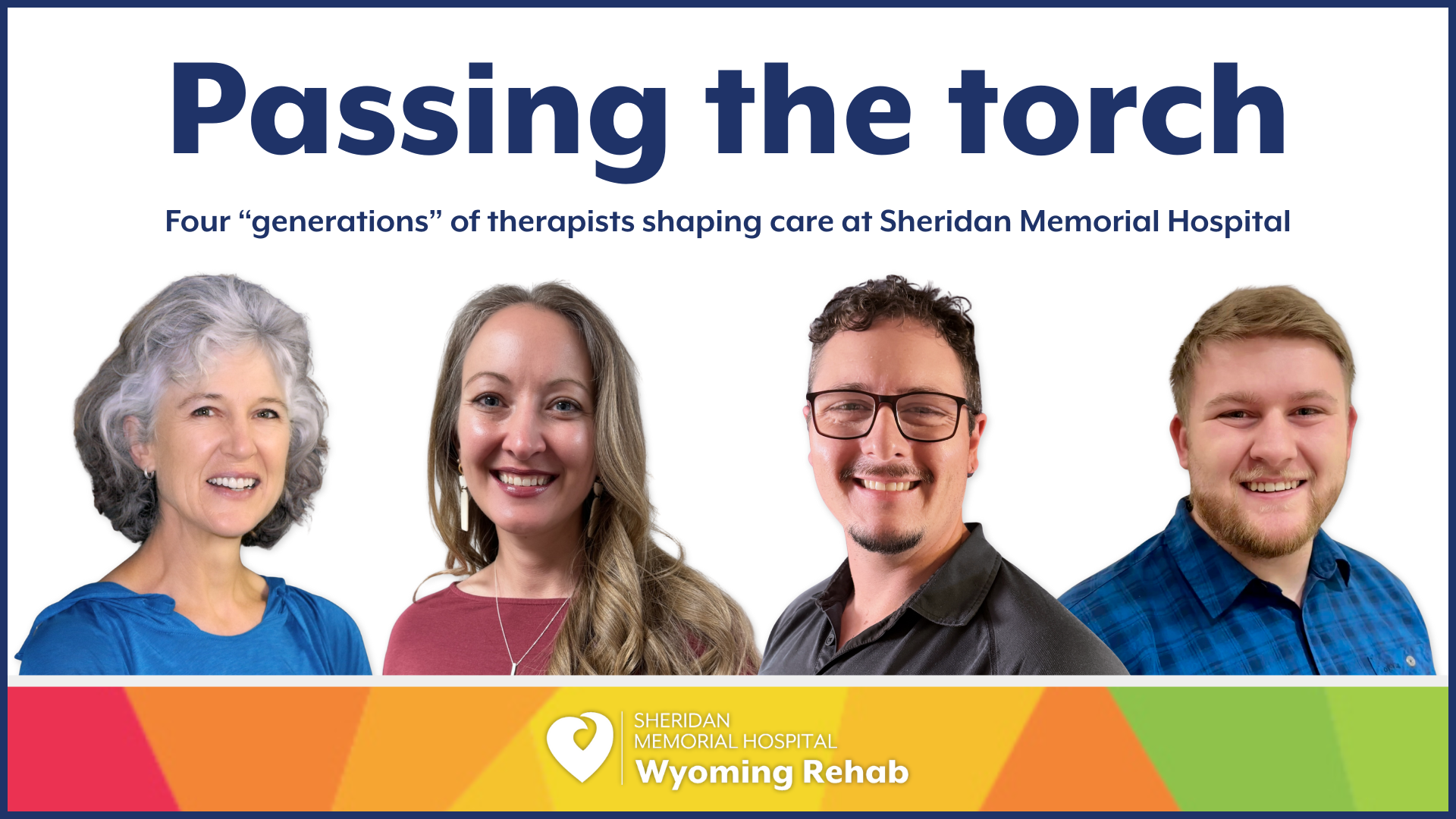
At Sheridan Memorial Hospital, serving the community with excellent, patient-centered care often goes far beyond medications, appointments and surgeries. It’s made possible through mentorship, teamwork and generations of shared experience among staff.
Within the Wyoming Rehab team, four “generations” of therapists—Lisa Mohatt, MS, PT, CWS, CLT; Tiffany Sutton, DPT, PT; Justin Bridger, DPT, PT, CSCS; and Dawson Eppe, PTA—represent more than two decades of learning, teaching and passing the torch.
All four are Sheridan natives. Each left to pursue their education and, in time, returned home—bringing with them not only skills and knowledge, but also a commitment to mentorship that continues to shape the culture and expertise of Sheridan Memorial Hospital’s outpatient and inpatient rehabilitation teams.
“We’ve been teachers for each other, and now we’re colleagues,” said Sutton, who has been a physical therapist on the hospital’s Transitional Care Unit (TCU) for the past eight years. “It’s kind of a weird coincidence.”
The mentorship story begins with Mohatt, a physical therapist at Wyoming Rehab’s outpatient clinic, who mentored Sutton when she was a student therapist. Years later, Sutton mentored Bridger, helping him log observation hours and writing a recommendation letter for his application to physical therapy school. Bridger then stepped into that same role for Eppe, mentoring him through his final clinical rotation as he earned his physical therapist assistant license from Laramie County Community College.
Today, Sutton and Eppe work side by side on the TCU floor, while Bridger and Mohatt support patients in Wyoming Rehab’s outpatient clinic—sometimes even treating those who have graduated from Sutton and Eppe’s care.
“It’s been super fun to connect with Tiffany as a colleague and have conversations with her as an equal,” shared Bridger, who has been with Wyoming Rehab since July 2024. “It’s pretty much unheard of to have four generations of therapists in the same organization. I can see how Lisa influenced Tiffany, how Tiffany influenced me and now how I’ve influenced Dawson.”
Each mentor shaped their successor in different ways. Mohatt exposed Sutton to every corner of the field—from outpatient rehabilitation to home health, wound care, and even aquatics. Bridger recalled how Sutton taught him to maintain high standards and recognize that patients are capable of far more than they often realize. When Bridger mentored Eppe, he emphasized adaptability and compassion.
“One of the things Justin hammered into me was that you have to be able to go from rehabbing a hip to, within 30 seconds, switching to a neurological mindset to rehab a stroke,” reflected Eppe, a physical therapist assistant on the TCU floor for the past three years. “His other big lesson was to lead with compassion. You can go from working with a patient having the best day of their life to another having the worst day of their life, and you have to be able to regulate your emotions and meet each patient where they’re at.”
Bridger remembered his time mentoring Eppe fondly, explaining that his goal was to help Eppe see every patient as a unique individual.
“Dawson was able to capture that lesson and make it his own,” Bridger said. “I’m sure he doesn’t treat every patient exactly the way I do—but that’s the point. Take a lesson and make it your own.”
That culture of sharing knowledge and making it one’s own goes both ways. When Eppe joked that he’s still waiting for the day Sutton or Bridger tell him they’ve used one of his exercises, Sutton laughed.
“Are you kidding?” she replied. “I use your hip hinge trick all the time!”
Bridger added that he’s learned something from every student, and that many times, it isn’t clinical knowledge he takes away from mentoring, but insight into different ways to approach and solve problems.
Mohatt agreed, noting that mentorship benefits both teacher and student.
“Mentoring has shown me that each generation has so much to offer, and how important it is to encourage that continued growth so physical therapists can keep helping people more effectively,” Mohatt explained.
The culture of mentorship extends beyond the workplace. Eppe is currently helping Sutton’s daughter recover following hip surgery—a full-circle moment for them both.
And as Eppe begins mentoring his own students, the legacy continues.
“It’s very humbling when you’re asked to teach the next generation,” he said. “When I’m teaching someone, that’s when I feel like I’m at the top of my game, because I have to keep up with the new things students are learning in school, while also showing them what the standard is. It also reminds you how awesome your job is.”
Sutton agreed, adding that growth and curiosity are key to lasting success in the field.
“The moment you think you know it all is when it’s time to hang up your hat,” she said.
Mohatt added that physical therapists play a vital role in a patient’s overall healthcare journey.
“It’s important for physical therapists to truly care about people and their health,” she said. “We need to understand our role in helping patients get better—not just physically, but mentally, as well.”
Together, this multi-generational approach to mentorship and healthcare creates more than professional growth. It fosters a positive, collaborative work environment and strengthens patient care. When knowledge, philosophy and compassion are intentionally passed from one therapist to the next, patients benefit from consistent, thoughtful care throughout their healthcare journey.
“Through community and mentorship, we become more than individuals,” Bridger said. “Through mentorship, we learn our own biases and reframe our thinking, which not only helps the next generation, but also improves care for our patients.”